A little sparkle. Endless possibilities.

How Is Glitter Made? From Film to Finished Flakes
See how some decorative glitter is made from prepared film, optical or color layers, cutting, and separation—and why the process differs between products.

Some decorative glitter is made by preparing a thin film or foil, adding the layers or surface treatment needed for its color and reflective effect, and cutting the material into small particles. That is a documented general route, not a description of every manufacturer or every glitter product. Other constructions and production sequences exist, and a retail listing usually does not disclose its full manufacturing process.
For example, patent publications describe film being coated and then cut, while other examples cut a substrate before applying a coating. These patents are useful evidence that processes vary; they do not establish how any specific Glittersmall SKU was made. The store’s product pages are the source for current product information, not a claim of in-house manufacturing.
A common film-to-flake process, step by step
1. Choose or prepare a thin substrate
A manufacturer begins with a thin sheet or film that can carry the desired finish and be cut into particles. Patent examples describe polymer films, metallized film, and cellulose-based films. The chosen construction affects flexibility, appearance, and how later steps can be carried out. No one substrate is used in every glitter product.
2. Add color, reflection, or an optical effect
A film can receive one or more coatings, pigments, reflective layers, or patterned structures. A highly reflective layer may increase brightness; color layers can change the base shade; and a patterned surface may disperse reflected light into different colors at different angles. Some processes apply these layers before cutting. Others coat particles after a cutting step. The design and end use determine which approach is appropriate.
3. Cut the coated material into a particle size and shape
The finished sheet may be cut, die-cut, chopped, or otherwise divided into small flakes. The tool and setup help determine the outline and dimensions: a regular shape such as a hexagon differs visually from a shard or a themed shape. Cutting also creates edges, which can matter to the performance of a particle in a particular medium. Published patents describe die and laser cutting in some processes, but the method is not universal.
4. Separate, inspect, and package
After cutting, particles may be separated from waste or backing, screened for size, checked for visual consistency, and packaged. Exact quality checks, tolerances, and batch controls depend on the producer and are not inferable from a product photograph. When a project depends on tight particle-size consistency, ask the supplier what specification and tolerance apply to the item and batch.
Why glitter looks different from one product to another
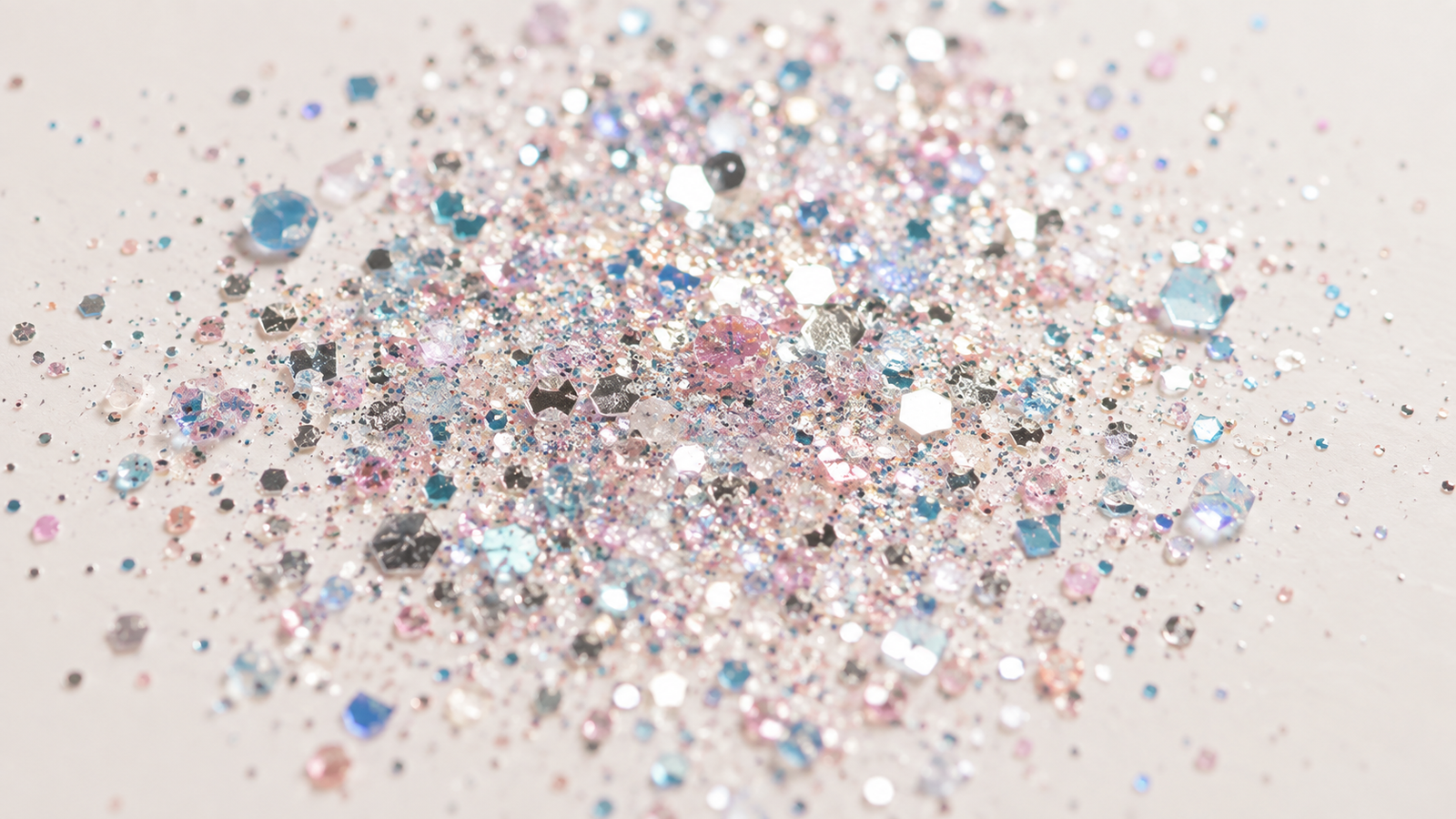
The appearance is not controlled by color alone. A very small particle can appear more like a continuous shimmer across a surface; a large particle is easier to distinguish individually and can create more texture. Hexagons reflect from regular flat faces, while shards produce a less uniform outline. Mixed-size glitter places several particle scales together, which can make the finished field look more layered than a single-size option.
Lighting and background also matter. A reflective face may flash brightly when it aligns with the light and viewer, then appear darker at another angle. Transparent and translucent particles allow the base color to influence the result. Product photos are helpful for comparison, but they cannot fully reproduce a project’s lighting, clear coat, resin depth, or display color settings.
Does all glitter use the same process?
No. Some particles are cut from finished film, some may be coated after cutting, and specialty products can use other substrate or shaping methods. Different materials and coatings can need different process controls. Even two products described with the same retail finish may not share identical construction.
That is why this overview should not be used to infer a product’s material, safety, durability, environmental performance, or suitability for a specific medium. For those questions, check the item-level specifications and request supporting documentation where needed. In particular, a general explanation of film cutting does not demonstrate that a particular glitter is cosmetic grade, biodegradable, solvent resistant, or compatible with a certain resin or coating.
Where do particle size and shape come from?
For cut-film glitter, particle size and outline are largely set by the cutting pattern and equipment. A regular punch or die can make repeatable shapes when the film and process are controlled; other methods can produce different edges or dimensions. In practical terms, a hexagon, star, and shard are not simply different colors of the same particle. Their outline changes how they pack together, how much edge is visible, and how individual pieces catch light.
Dimensions on a listing are more useful than broad descriptors such as “fine,” “large,” or “chunky,” but buyers should still confirm what the measurement describes and whether a product is one size or a mix. A mixed-size product contains multiple stated dimensions, so its coverage and visual balance may vary from a single-size product. Where size uniformity matters for a production run, ask what tolerance applies; a marketing title alone is not a tolerance specification.
Why coatings and cut edges matter
A surface layer can affect brightness, color, resistance, and how a particle behaves in a surrounding liquid or binder. Cutting a coated sheet creates exposed edges in many designs. Patent literature discusses ways of constructing or coating glitter to address the behavior of cut edges in particular applications. This does not mean every product has the same edge structure or that a described coating makes a particle compatible with every solvent, cosmetic, adhesive, or resin.
For buyers, the useful lesson is to match the glitter to the complete process. Consider mixing, application, curing or drying, and the final surface rather than just how the dry particles look in a jar. Follow the instructions from the medium manufacturer, and use the glitter supplier’s product data for compatibility. When a formula, finish, or production process is sensitive, a small controlled test is better evidence than a general article or another product’s results.
What a product listing can and cannot tell you
A clear listing can help you compare a named color, particle size, shape, effect, available variations, and intended application. Those details support a purchasing decision. A listing title or photograph usually cannot establish the full layer structure, factory equipment, quality-control tests, regulatory status, or environmental outcome. Ask the supplier for a data sheet or other primary documentation if one of those facts matters to your project.
Glittersmall’s catalog groups products so shoppers can browse by finish and particle style, including holographic, iridescent, extra fine, and shard glitter. These are navigation labels based on product listings; consult each product page for the specific item information available at the time of purchase.
How different constructions lead to different particle properties
A simple cut-film explanation is useful, but it leaves out the decisions made before and after the cutting stage. A manufacturer may select a carrier that suits a target thickness, apply a reflective or colored layer, protect a surface, emboss a pattern, cut particles to shape, or coat a particle after cutting. Not every product uses each step. A patent is a record of one described invention and set of examples, not a technical manual for the whole glitter market.
The construction can influence how a particle looks and behaves, but it cannot be read from the retail finish name alone. A reflective appearance does not reveal whether reflection comes from a metallic layer, a pigment, or another surface structure. A translucent look does not identify the carrier. If the chemistry, safety, compatibility, or environmental performance is important, process descriptions from another manufacturer are not a substitute for the specific product data.
What published process examples can establish
Patent publications can establish that a particular process was described, such as coating a film and cutting it into flakes, or separating one flake product from a substrate that is later cut into glitter. They can help explain why production sequences vary and why the word “glitter” covers different constructions. A patent does not prove that a particular manufacturer practices the method, that it is the dominant industry method, or that an item purchased from a retailer was made that way.
For a buyer trying to compare finished products, the reliable facts are the details tied to the item: stated size, shape, color, finish, available pack options, and any material or use documentation. For a manufacturer or commercial buyer who needs process traceability, ask the supplier for records that identify the source, batch, and construction. If the answer has regulatory significance, have the relevant technical or compliance reviewer confirm it.
A practical checklist for buyers
- Compare the particle size and outline you need, not only the color or finish name.
- Check whether the item is a single size or a listed mixture of sizes.
- Review the product’s stated material and intended-use information; ask for a current document if it matters.
- Test the product in the actual binder or base before using it in a large or repeated run.
- Do not infer manufacturing controls, cosmetic approval, environmental performance, or solvent compatibility from a patent example or catalog image.
Compare finished glitter by its visible specifications
For shopping, the most useful comparison is often the finished particle rather than an assumed factory process. Review stated particle size, shape, base color, effect, and available package options. Explore holographic glitter, iridescent glitter, extra fine glitter, and shard glitter. Open the individual product page to verify exact details before choosing.
Finished product examples: size, shape, and effect
The products below show how the finished catalog can vary in particle format. They are examples of available product listings, not evidence that one shared production method was used for all of them.

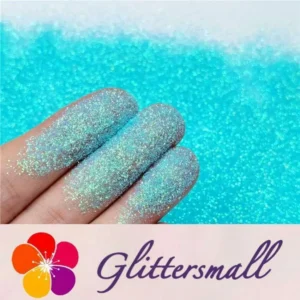
0.2mm Iridescent Translucent Blue Glitter C007
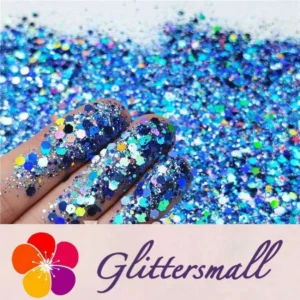
Price range: ¥2.99 through ¥45.99Select options This product has multiple variants. The options may be chosen on the product pageGeneral Mixed Holographic Sea Blue Glitter Hexagon Shaped LB0709
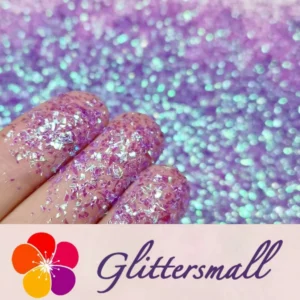
Price range: ¥2.99 through ¥45.99Select options This product has multiple variants. The options may be chosen on the product pageIridescent Cellophane Glitter Shards (Flakes) C006 2×2
Price range: ¥2.99 through ¥45.99Select options This product has multiple variants. The options may be chosen on the product page
Frequently asked questions
How is glitter made from plastic film?
In one documented method, a film is coated or metallized to create a visual effect and then cut into small particles. Patent examples show this route, but the substrate and sequence vary by product.
Is glitter cut before or after it is coated?
Both sequences appear in patent descriptions. Some processes coat a film and then cut it; others describe coating particles after cutting. The exact process depends on the material and product design.
How are glitter shapes made?
Shapes can be created by cutting the sheet or film with a tool designed for a particular outline. Regular geometric shapes, shards, and themed outlines require different cutting patterns; product dimensions should be checked on the listing.
Does holographic glitter contain a real hologram?
Not necessarily. “Holographic” is often a retail description for a rainbow-like, angle-dependent visual effect. It does not guarantee that loose glitter forms a three-dimensional holographic image or uses one particular process.
Can I know the factory process from a product photo?
No. A photo can help assess color, shape, and visible finish, but it cannot verify substrate, coatings, process sequence, safety status, or manufacturing controls. Request product documentation for those details.
Sources and further reading
These patent publications document selected production examples: Method for Producing Glitter and Producing Two Distinct Flake Products Using a Single Substrate. Patent descriptions illustrate specific inventions, not every manufacturer’s process and not the process used for a particular store item.
https://addlinks.pro/vsb79