A little sparkle. Endless possibilities.

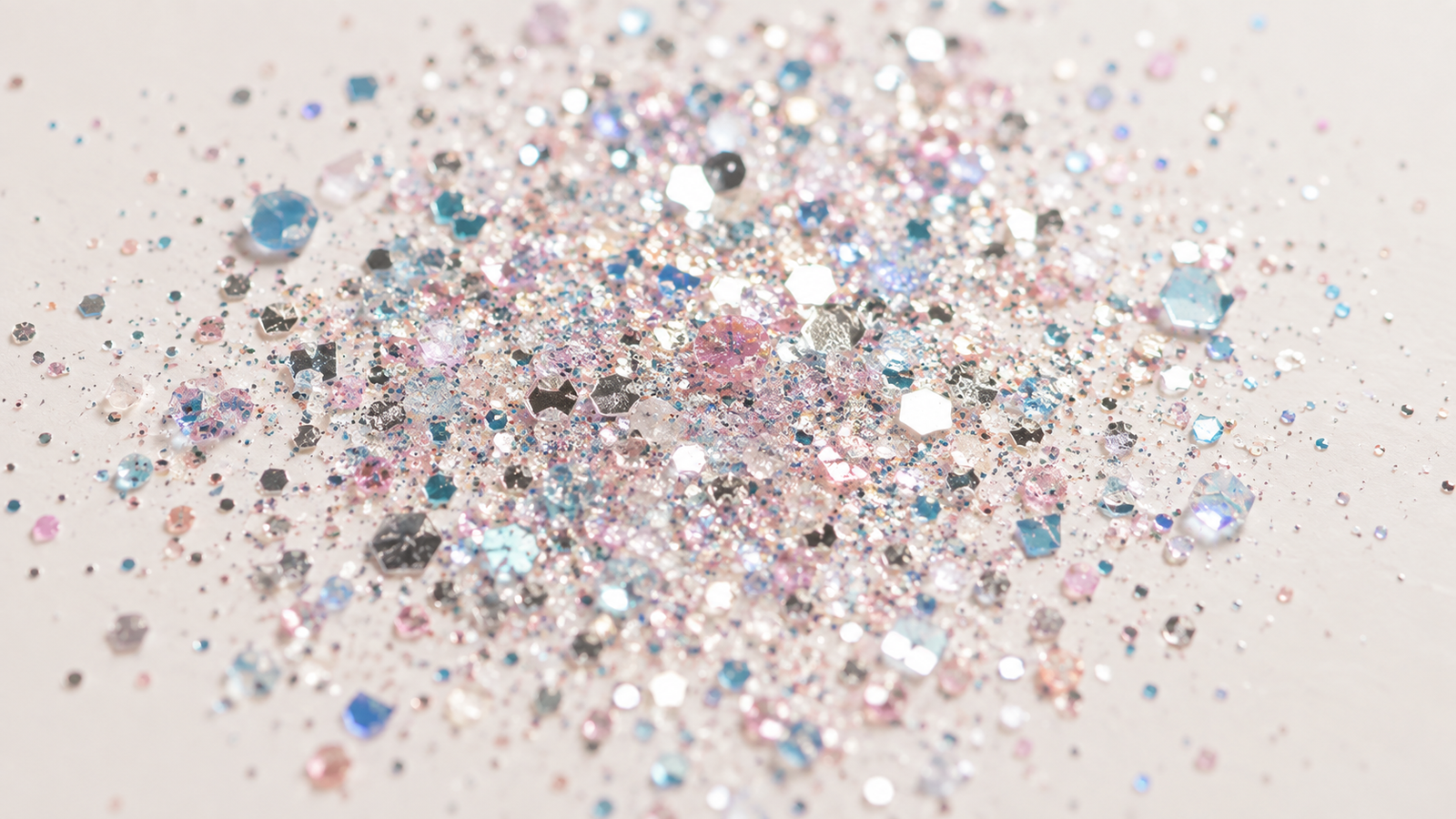
Holographic vs. Iridescent Glitter: What’s the Difference?
Compare holographic and iridescent glitter by appearance, transparency, size, and real product examples. Learn what retail finish labels can and cannot tell you.

Holographic and iridescent glitter can both shift color as the light or viewing angle changes, but the words point to different visual descriptions. In craft listings, “holographic” commonly signals a more obvious rainbow-like flash, while “iridescent” often describes a softer shift or a translucent base with changing highlights. Retail terms are not perfectly standardized, so inspect the actual product photos, size, color, and description rather than choosing by label alone.
For a real catalog comparison, Glittersmall lists General Mixed Holographic Sea Blue Glitter Hexagon Shaped LB0709 and 0.2mm Iridescent Translucent Blue Glitter C007. Their names identify different listed effects and formats; the first is a mixed-size holographic hexagon product, while the second is listed as 0.2 mm, iridescent, translucent blue. Open each listing for current variations, images, and item details.
What does “holographic” glitter look like?
In many craft and decorative listings, holographic glitter produces a pronounced spectrum-like flash. Some materials achieve angle-dependent color through structured surfaces that diffract light; other effect constructions use layered optical films or combinations of techniques. The visible rainbow can move as the particle, light source, or viewer moves. The term in a retail listing is an appearance label and does not by itself confirm a specific microscopic structure or a scientifically recorded hologram.
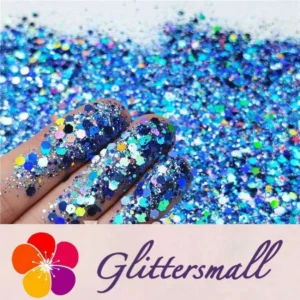
The mixed sea-blue LB0709 listing is a practical example of why finish and size should be considered separately. It is named as holographic and hexagon-shaped and its product description lists five sizes: 0.2, 0.3, 0.4, 1, and 2.5 mm. A mix of sizes will not have the same visual distribution as a single-size particle, even when the color family and finish are similar.
What does “iridescent” glitter look like?
Iridescence describes color that changes with viewing or illumination angle. Depending on the product, the base can look translucent or pearly, with a colored highlight that becomes stronger or weaker as the surface moves. In optical materials, angle-dependent colors can result from interference, diffraction, or other structured interactions with light. The word does not identify one universal construction.
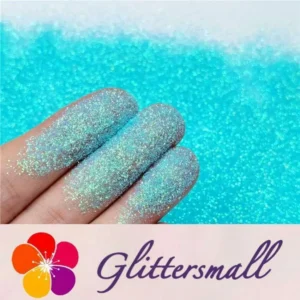
The C007 example is titled “0.2mm Iridescent Translucent Blue Glitter.” Those listing details are useful when the project calls for a small, translucent blue particle rather than a visibly mixed-size hexagon. Its title and photographs are not evidence about composition or application suitability, so check the exact item page for those questions.
Holographic vs. iridescent: a practical comparison
| What to compare | Holographic listing | Iridescent listing |
|---|---|---|
| Typical shopping expectation | A distinct, rainbow-like flash is often the reason shoppers choose it. | An angle-dependent color shift, sometimes with a softer or translucent appearance. |
| What the term confirms | A retailer’s finish description; not necessarily a true 3D hologram or one specific optical structure. | A retailer’s effect description; not one guaranteed substrate or coating. |
| What to verify | Base shade, particle size, shape, lighting in photos, and the product’s own details. | Transparency, base shade, particle size, shape, and appearance over the intended background. |
| Catalog example | Mixed Holographic Sea Blue LB0709, listed as mixed-size hexagons. | Iridescent Translucent Blue C007, listed at 0.2 mm. |
Which finish should you choose?
Choose based on the finished surface, not on a presumed technical distinction. If you want a clear rainbow flash, start with products listed as holographic and look closely at their images under direct light. If you want a subtler shift or translucent color, compare iridescent listings and note the background shown. For a controlled result, test a small amount on the actual substrate, base color, and lighting before committing to a large project.
Particle size can matter as much as the finish. Fine glitter may appear more evenly distributed; larger particles can create more visible flashes and texture. Shape also changes how particles sit and reflect. Compare actual dimensions and outlines on the listing, and remember that a mixed-size product will produce a different coverage pattern from a single-size product.
When planning the amount of contrast, consider the base beneath the glitter. A translucent iridescent particle may allow a colored base or clear medium to remain visible, while a more opaque or strongly reflective particle can cover more of the background. This is a general visual consideration, not a guarantee about every item sold under either label. Look for a product photo on a similar background or test a small amount on the actual project surface.
Also consider the movement in the finished piece. A flat sample under fixed lighting might not show the same shifts as a tumbler, jewelry piece, nail design, or decoration that moves through different angles. A lighting test can help: view a sample under the intended light, tilt it, and compare it both at close range and from the distance where people will see it. This simple check reveals whether the visual effect is strong enough and whether the base shade stays true to the design.
For any use involving skin, lips, eyes, resin chemistry, solvents, or other performance-sensitive applications, effect names are not compatibility statements. Check the intended-use notes and supporting product documentation. Do not treat a visual comparison as evidence of cosmetic status, safety, durability, or environmental certification.
How to compare listings without relying on labels alone
Compare the same attributes in the same order: first the base color and transparency, then particle dimensions and shape, then the effect name, and finally the pack size and intended use. This prevents a mixed-size holographic product from being compared with a single-size iridescent product as if finish were the only difference. For the two Glittersmall examples above, the stated size mix and the 0.2 mm translucent format are meaningful distinctions independently of the finish labels.
Product photography can also vary by background, exposure, and lighting. A rainbow flare in a photograph may be enhanced by direct light or editing, while a translucent product may be photographed over a dark surface to reveal its shape. Use images as visual references, but confirm the written specifications and ask for additional images or details if the purchase depends on a close match. For a larger quantity or repeat production, document the product name and selected variation so the next order can be compared consistently.
A three-part test for comparing the finish
You can make a more useful comparison with a small, repeatable visual test. Place a small amount of each product on the same neutral background, then on the actual base material. Keep the distance from the light source and the viewing angle roughly the same. First compare the base color with the samples held still. Next tilt each sample under direct light and look for the direction and intensity of the color shift. Finally, step back to the distance at which the finished project will be viewed. This helps separate a strong close-up sparkle from an effect that reads clearly at normal viewing distance.
For a fair comparison, note any attributes that are not matched. If one sample is a mixed-size hexagon product and the other is a single-size translucent particle, the result reflects particle size, outline, coverage, and finish together. You cannot attribute every difference to “holographic versus iridescent.” To isolate the finish, use samples with the closest available color, shape, size, and background, then compare the photos and listing details for what still differs.
Optical terms in plain language
Iridescence is a broad description for color that changes with the direction of viewing or illumination. Interference between light reflected by layers can produce this kind of angle-dependent color; surface structures can also diffract light and create changing colors. Holography has a more specific technical meaning involving recorded information about light waves. In consumer product names, however, “holographic” is often used as a convenient descriptor for a vivid rainbow effect. The 2023 review cited below discusses this difference in terminology for effect pigments.
This is why the two words should be treated as shopping descriptions first. They provide a useful expectation, but they are not a complete laboratory classification. If a project depends on a particular optical mechanism, color travel, reflectance, or repeatable appearance, request technical data or a sample from the supplier. A consumer title, product photograph, and a general article cannot establish those instrument-level properties.
How to make the choice for a real project
For a bright, multicolor accent, start with a holographic category and shortlist products whose actual images show the amount of rainbow flash you want. For a softer color shift or a base that lets the background influence the appearance, compare iridescent listings and verify whether the item is described as translucent. Then narrow by the particle dimensions and shape that fit the project scale. These are starting points; the product page and your own sample remain the best final check.
Explore the two finishes
Browse the current holographic glitter collection and iridescent glitter collection. To compare particle styles beyond finish, see extra fine glitter and glitter shards. Category membership helps narrow the catalog; product-level details should guide your final selection.
Examples with different blue finishes
These live listings let you compare a sea-blue mixed-size holographic product, a translucent blue iridescent product, and a sky-blue mixed-size holographic product. Note that size and transparency also differ, so this is a real-world shopping comparison rather than a controlled optical test.

0.2mm Iridescent Translucent Blue Glitter C007
Price range: ¥2.99 through ¥45.99Select options This product has multiple variants. The options may be chosen on the product pageGeneral Mixed Holographic Sea Blue Glitter Hexagon Shaped LB0709
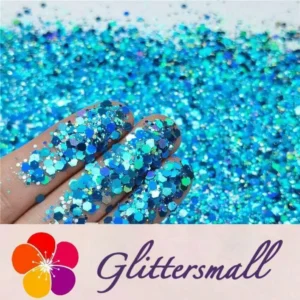
Price range: ¥2.99 through ¥45.99Select options This product has multiple variants. The options may be chosen on the product pageGeneral Mixed Holographic Sky Blue Glitter Hexagon Shaped LB0700
Price range: ¥2.99 through ¥45.99Select options This product has multiple variants. The options may be chosen on the product page
Frequently asked questions
Is holographic glitter the same as iridescent glitter?
No. Both can show changing colors, but “holographic” commonly describes a more obvious rainbow-like flash and “iridescent” a broader angle-dependent color shift. Retail use varies, so check product images and details.
Does holographic glitter show every rainbow color?
Not necessarily. The visible colors depend on the product, light source, viewing angle, background, and photography. Review several product images and test the material in the intended setting when the exact color matters.
Is iridescent glitter always transparent?
No. Some iridescent products are listed as translucent, while others may look opaque or have a different base. Confirm transparency and base color on the specific product page.
What is a real difference between the Glittersmall examples?
The sea-blue holographic example is listed as a mixed-size hexagon product with five sizes. The translucent blue iridescent example is listed at 0.2 mm. These facts come from their product titles and description; check the live pages for current variations and full details.
Which finish is better for resin?
Neither finish is automatically better. The right option depends on the look, particle size, transparency, resin system, and project method. Confirm compatibility with the exact product and test a small sample before use.
Common comparison mistakes to avoid
The first mistake is treating the labels as strict material standards. In everyday shopping, two sellers can use the same word for products with different particle sizes, colors, and constructions. The second is comparing photographs taken under different lighting and attributing every change in brightness to the finish. The third is assuming that a rainbow look means an object is a hologram in the technical sense. These assumptions can lead to a mismatch even when the chosen category sounds right.
A better comparison starts with the physical details you can verify: listed dimensions, outline, transparency, product color, and example images. Then check the effect description and compare a sample in the target lighting. If the visual result is business-critical, ask the supplier for a sample or technical information rather than relying on marketing terminology alone. If the application also has safety or compatibility requirements, treat those as a separate documentation check.
Sources and further reading
A review in the Journal of the International Colour Association discusses how technical optical terminology and consumer uses of “holographic” for effect pigments can differ. Patent examples describing structured or layered glitter constructions include Method for Producing Glitter. These sources support the general explanation above, but do not replace product-specific specifications.
https://addlinks.pro/df3BY