A little sparkle. Endless possibilities.

What Is Glitter? Types, Shapes, Sizes, and Uses
Glitter is a decorative material made of small reflective particles. Learn how particle size, shape, color, and finish affect its look, and what to check before choosing a product.

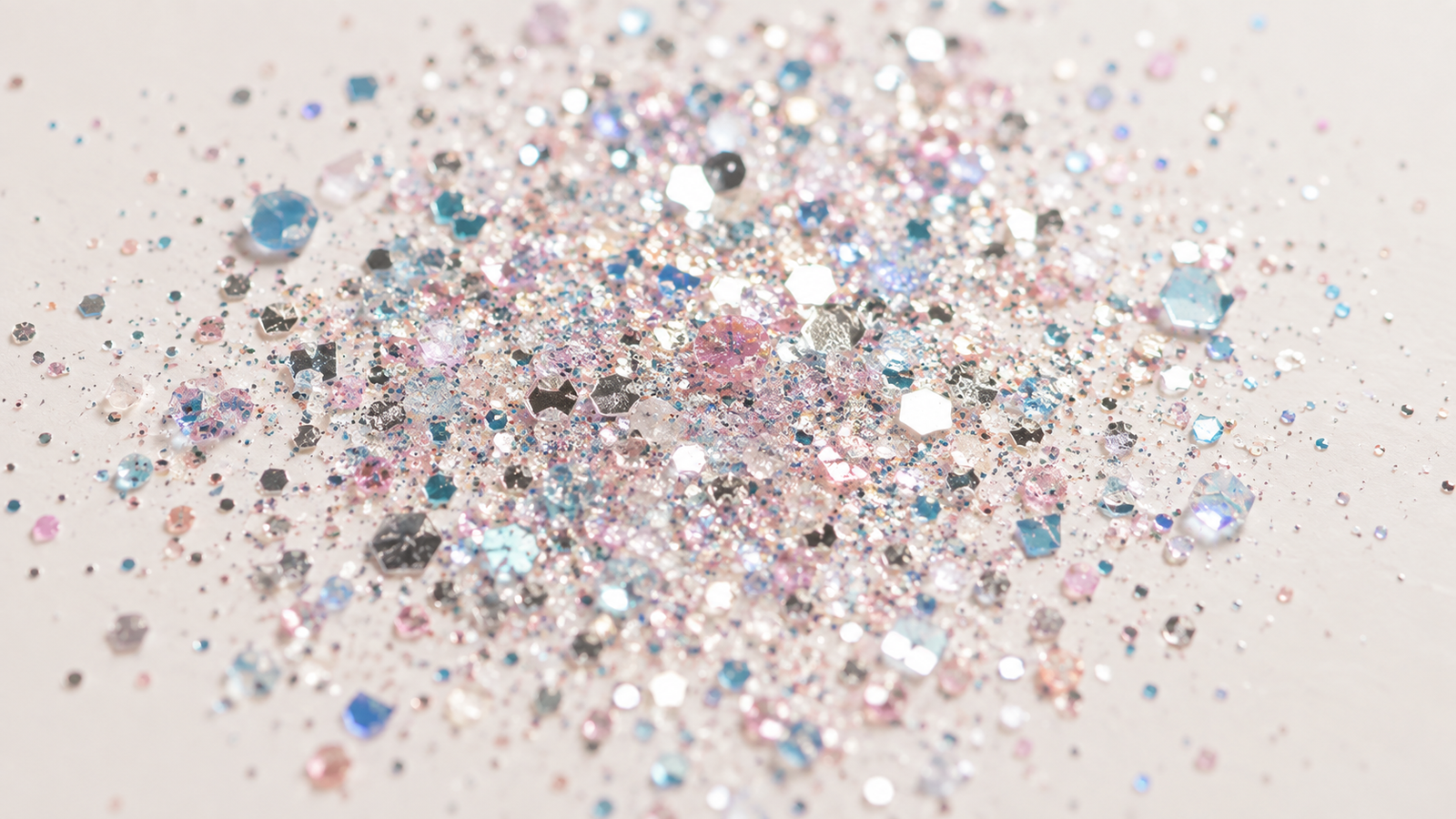
Glitter is a decorative material made of small, flat particles that reflect or scatter light. Those particles may be cut into shapes such as hexagons, stars, or shards, and their appearance depends on the particle size, color, surface finish, and the way light reaches them. The word describes a visible effect and product form; it does not identify one universal material or recipe.
That distinction is useful when shopping. Two products both called glitter can look very different in a project: fine particles can create a more even field of sparkle, while larger shapes are easier to see individually. A holographic finish can throw several colors as the viewing angle changes, while an iridescent finish often has a softer color shift. Always check the specific product listing for its stated size, shape, color, pack options, and intended use.
What makes glitter sparkle?
A glitter particle has a broad, thin face relative to its edge. When light hits that face, some of it reflects toward the viewer. Many particles sit at slightly different angles, so they return light in different directions as a surface moves or the light source changes. Metallic-looking finishes, transparent color, reflective layers, and patterned surfaces can all change the effect. The visible result also depends on the background: clear particles may look subtle over a pale base and more pronounced over a dark one.
Some specialty films use surface structures that separate light into colors. In consumer craft products, “holographic” is often used to describe a rainbow-like visual effect; it does not necessarily mean the loose particles form a three-dimensional hologram. Technical research on effect pigments also cautions that commercial uses of “holographic” and “iridescent” do not always follow strict optical definitions.
Glitter size, shape, and finish are different choices
Size describes how large each particle is; shape describes its outline; finish describes how it interacts with light. These are independent attributes. A small hexagon can be holographic, and a larger shard can be iridescent. Product names and category labels help narrow a search, but the listing’s actual dimensions and photographs are the better guide when a specific result matters.
- Fine particles: useful when the design calls for a more continuous sparkle or a less prominent texture. Compare the listed particle dimension rather than relying on “fine” alone.
- Chunky or mixed-size particles: create visible points and texture. A mixed-size product combines more than one listed size, so the distribution may look less uniform.
- Shards and flakes: have an elongated or irregular-looking outline compared with a regular hexagon. See the shard glitter collection.
- Shaped glitter: includes recognizable outlines such as stars or hearts. Browse glitter by shape.
How do you choose a type of glitter?
Start with the surface and the visual scale you want. For a fine, even-looking layer, compare smaller listed particle sizes. For a dimensional accent, look at larger shapes or mixed sizes. Then choose color and finish under lighting similar to the finished project. Screen images can shift color, and reflective particles can look different when tilted, photographed, or placed over a different background.
Finally, confirm material and application suitability. “Glitter” alone does not establish whether a product is appropriate for skin, lips, eyes, nails, resin, paint, or another medium. Check the exact product description and supplier information. For skin-contact or cosmetic projects, use only a product whose listing and supporting documentation explicitly cover the intended area and application; do not infer that a craft product is cosmetic grade from its appearance.
How particle size changes the finished surface
Particle size changes both the look and the way glitter behaves while you work. Smaller particles tend to create a denser-looking field when spread across a surface. The individual flashes may be less visually distinct from a normal viewing distance, which can make the overall finish read as shimmer. Larger particles are easier to see as separate shapes and can make a design feel more textured or dimensional. These are visual tendencies, not guarantees: particle orientation, density, base color, lighting, and adhesive or binder can all change the result.
For a planned layer, think about the final viewing distance. A tiny detail viewed close up can use a different scale than a decoration meant to be seen across a room. If the glitter will be mixed into a coating or resin, the particle size and thickness may also affect how evenly the mixture spreads and the level of the cured surface. Because each medium behaves differently, consult the material supplier’s directions and test a small sample instead of assuming the same particle will perform identically in every base.
Choosing color and finish from product photos
Product photos can show shape and relative scale, but reflective finishes are especially sensitive to photography. A direct light source can make a particle appear brighter or more rainbow-like than it will under diffuse room lighting. A pale or dark background can also alter the apparent contrast. If a project depends on matching an existing color, compare more than one image and, when available, order a small quantity before planning a large batch. A display monitor is not a color-measuring instrument.
Keep the terms “color,” “finish,” and “transparency” separate while comparing. Blue is a base color family; holographic or iridescent describes a listed effect; translucent describes how much of the background may show through. One product can have all three properties. Reading each attribute independently helps avoid choosing a clear, color-shifting particle when the design needs a solid blue surface, or a mixed-size glitter when the design needs a uniform field.
A quick selection checklist
Before placing an order, write down the result you need and compare each listing against it: particle dimensions, shape, base shade, finish, transparency, package size, and documented application. If one of these details is missing and it affects the project, ask for clarification. This is more reliable than choosing by a broad phrase such as “craft glitter” or by an image that looks similar. For repeated production, confirm whether the same specification and pack option are available for the quantity you need.
Glitter and sequins: what is the difference?
The terms can overlap in casual conversation, but they usually suggest a different scale and construction. Glitter generally means small loose flakes or particles that are spread, mixed, or applied in a layer. Sequins are typically larger decorative pieces that are attached individually or in a more controlled arrangement. A shaped glitter piece can be larger than a fine particle, so the product name alone may not settle the distinction. Look at the dimensions, thickness, and intended application on the specific listing.
This distinction can help with planning coverage. A loose particle product can fill gaps and create an overall field, while larger pieces are more visible as individual accents. If a pattern needs a recognizable motif, shaped glitter or sequin-like pieces may be easier to place deliberately than very fine particles. If a smooth surface is important, consider how much binder or clear layer the project requires and test the finished surface before scaling up.
What does “glitter” mean in a product category?
Online categories are a browsing aid. A color category such as blue glitter groups products by their listed shade; an effect category such as holographic glitter groups products by the finish described on the listing; and a shape category groups them by outline. These dimensions can overlap, so the same product might appear in more than one relevant group. Category placement does not replace the specific title, options, dimensions, material notes, or application information on the product page.
For example, a shopper might first choose a color family, then compare fine particles with mixed-size hexagons, and finally decide whether the visual result should be holographic or iridescent. That sequence is more reliable than searching one long phrase and assuming every matching result has identical characteristics. Start broad, use the category to find plausible options, and then check the individual item before buying.
A simple sample test before a larger project
When the finished appearance matters, prepare a small sample using the same base color, binder, application method, and lighting planned for the final work. Observe whether particles remain where placed, whether their color is masked by the base, and whether the surface has more texture than expected. Let coatings cure or dry according to their manufacturer instructions before evaluating the result. A sample test can reveal visual fit and process compatibility, but it does not prove regulatory status, long-term durability, or safety for body contact.
Explore glitter by the quality you need
For a specific finish, compare holographic glitter with iridescent glitter. To narrow by particle size, visit extra fine glitter. If the project needs a larger, visible shape, compare shards and flakes or browse shaped glitter. Each product page is the final reference for the available options and stated specifications.
Compare different particle styles in the catalog
These examples show different listed formats and effects. Compare the individual product pages for current sizes, variations, and intended-use details; the products illustrate the catalog, not a universal definition of glitter.

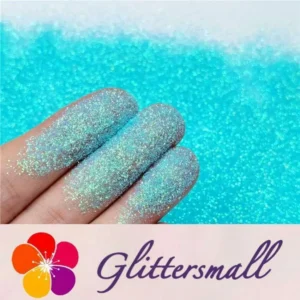
0.2mm Iridescent Translucent Blue Glitter C007
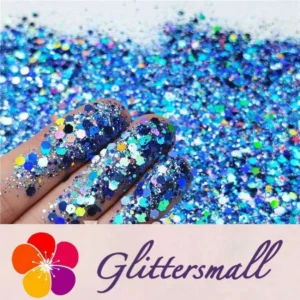
Price range: ¥2.99 through ¥45.99Select options This product has multiple variants. The options may be chosen on the product pageGeneral Mixed Holographic Sea Blue Glitter Hexagon Shaped LB0709
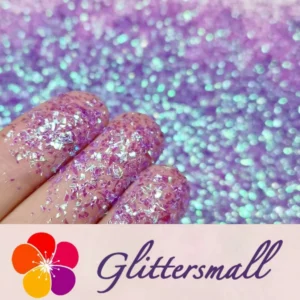
Price range: ¥2.99 through ¥45.99Select options This product has multiple variants. The options may be chosen on the product pageIridescent Cellophane Glitter Shards (Flakes) C006 2×2
Price range: ¥2.99 through ¥45.99Select options This product has multiple variants. The options may be chosen on the product page
Common questions about glitter
Is glitter a material or an effect?
It is both a product form and a visual effect. Glitter is sold as small reflective particles, but those particles can be made from different substrates and finishes. The word alone does not tell you the full composition.
What is the difference between fine and chunky glitter?
The main difference is particle scale and the texture it creates. “Fine” and “chunky” are broad retail labels, so compare the exact dimensions listed for the individual product before choosing.
Can any glitter be used on skin or around the eyes?
No. A craft label does not establish cosmetic suitability, and suitability can differ by body area and local requirements. Use only products with documentation for the intended application and follow their instructions.
Does glitter always contain plastic?
No single answer applies to every product. Particle substrates and coatings vary, so check the exact item’s material information. A category name or color effect is not proof of composition or environmental performance.
Choosing a particle for a project medium
A surface decoration, a suspended particle in a transparent casting, and a powder mixed into a coating place different demands on glitter. A flat adhesive surface may hold visible shapes in place; a liquid medium may let particles settle, clump, or orient in ways that change the final appearance. A fine particle may distribute differently from a mixed-size flake, while a transparent base may reveal the color of the material underneath. These are project variables, not universal product promises.
Before choosing a product, review directions from both the glitter supplier and the base-material manufacturer. Confirm that the selected particle size, shape, and stated use fit the method. Try a small sample with the same mixing ratio, application thickness, and cure or drying conditions planned for the finished work. If the project involves skin, lips, or eyes, verify suitability through explicit documentation for that intended area; an attractive appearance or a general craft recommendation is not a substitute.
Sources and further reading
For examples of documented glitter constructions and cutting methods, see the patent Method for Producing Glitter. For the distinction between technical optics and consumer “holographic” labeling, see the 2023 review in the Journal of the International Colour Association. These references describe examples and terminology; they do not specify the composition of every product in this store.